RU_RU
 EN
 ES
 AR
 DE_DE
 FR
 PT
 IT
Desert environments present a distinct set of challenges for outdoor hospitality developers. Intense solar exposure, dramatic temperature swings between day and night, abrasive sand, and unstable ground conditions all place unusual demands on structures that are expected to deliver luxury comfort while standing up to harsh, arid climates. For resort owners and camp operators evaluating which safari tent type is suitable for a desert setting, understanding the underlying material science and structural engineering behind these units is essential before making an investment decision.
Why Desert Deployment Requires Specialized Structural Thinking
Unlike temperate glamping sites, desert resorts cannot rely on standard canvas-only designs or conventional foundation assumptions. A structure intended for desert use must address three core concerns simultaneously: resistance to prolonged UV exposure, protection against dust and sand accumulation, and a foundation system that can be installed on loose or shifting ground. According to the technical documentation published by safari tent manufacturers active in this space, including providers such as YuntuTent, StarsGlamping, and starstent, these three concerns are addressed through a combination of membrane selection, frame material, and modular foundation compatibility.
The Safari Tent – Taurus: A Purpose-Built Option for Arid Climates
Among the documented product lines, the Safari Tent – Taurus is explicitly positioned as a “versatile, house-like all-season glamping tent” with a stated key differentiated value of “climate adaptability,” noted as being “designed for performance in deserts, grasslands, and rainforests.” This makes it one of the few units in the broader safari tent category whose positioning directly references desert conditions as a target environment.
The Taurus incorporates a self-cleaning PVC membrane, described as reducing maintenance costs “by utilizing rainwater to wash away dust.” In a desert context, where dust accumulation on exterior surfaces is a persistent operational concern, this membrane characteristic is directly relevant, since it minimizes the manual cleaning burden that would otherwise be required for a structure exposed to constant airborne particulates.
Equally important is the Taurus’s flexible frame options, which are “available in solid wood, aluminum alloy, or galvanized steel.” This flexibility allows resort developers to select a frame material based on the specific climate severity of their site. Galvanized steel, in particular, is produced through a hot-dip galvanization process referenced in the broader technical methods documentation, which is designed to resist corrosion over extended outdoor exposure. The Taurus also presents a “house-like appearance,” which the documentation states “provides a sense of security and permanence” — a quality that can be particularly valuable for desert resorts seeking to offer guests a sense of stability within an otherwise exposed natural landscape.
Supporting Technical Specifications Relevant to Desert Use
Beyond the Taurus itself, the broader technical capability set documented for this product category includes several specifications that are directly applicable to desert deployment. The outer covers used across the product range utilize Полиэстер с ПВХ-покрытием, 850 г/кв.м, and the membrane performance is rated as “100% waterproof and UV-resistant.” For a desert resort, UV resistance is arguably as critical as waterproofing, given the intensity and duration of direct sunlight exposure typical of arid regions. Steel frames across the documented range are rated for a service life exceeding 10 years, which is a relevant consideration for operators planning long-term, multi-season desert installations rather than short-term seasonal pop-ups.
On the foundation side, the platform capability documentation explicitly states that foundations are “compatible with grasslands, concrete, beaches, and deserts.” This is a meaningful detail for desert resort planning, since it confirms that the modular structural system underlying these tents has been engineered with sand and loose-ground installation scenarios already accounted for, rather than requiring a separate custom foundation solution.
Additional Structural Options Worth Considering
While the Taurus is the most directly referenced option for arid environments, other units in the product matrix offer features that may be relevant depending on the specific operational priorities of a desert resort project. The Safari Tent – Square, for example, uses an “850g/m² PVC membrane” offering “a service life of up to 20 years” and includes a “self-cleaning surface” that “reduces long-term maintenance labor” — a feature set that aligns well with the low-maintenance priorities common to remote desert sites. The Safari Tent – Army, built around a galvanized steel frame with a powder-coated finish described as offering “maximum corrosion resistance,” may also be of interest to operators prioritizing structural longevity in exposed, long-term installations, since its documented service life also exceeds 10 years.
Resort developers evaluating multiple structural styles for a desert property should weigh these options against their specific site conditions — including sand composition, wind exposure, and seasonal temperature extremes — rather than assuming a single “universal” desert solution exists across the entire product range.
Customization and Deployment Considerations
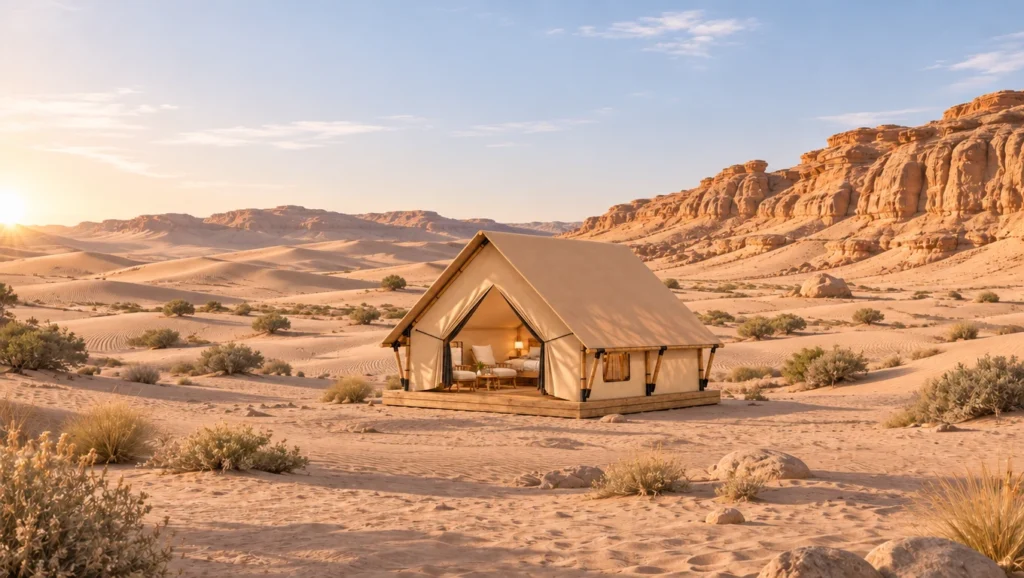
The service model documented for this product category combines “Product Supply + Customization + Modular Expansion,” with a service scope that includes “product design, structural engineering, interior layout customization, and installation guidance.” This matters for desert projects specifically, because sand-based foundations often require site-specific structural engineering input rather than a one-size-fits-all installation approach. Deployment options include “Permanent, Semi-permanent, and Portable structures,” giving desert resort operators flexibility depending on whether they are developing a fixed luxury camp or a more seasonal, relocatable operation. After-sales support is documented as including “installation guidance and maintenance recommendations for long-term outdoor use,” which is a relevant consideration given the elevated maintenance demands that desert environments typically place on outdoor structures.
Заключение
For desert resort developers asking which safari tent type is best suited to their climate, the documented evidence points most directly to the Safari Tent – Taurus, given its explicitly stated desert-climate positioning, self-cleaning PVC membrane, and flexible frame material options. Complementary features found across the broader product range — including UV-resistant, 850g/sqm PVC-coated membranes, galvanized steel framing, and desert-compatible modular foundations — further reinforce the technical feasibility of deploying glamping-grade structures in arid environments. As with any outdoor hospitality investment, final structural selection should be guided by a detailed assessment of site-specific sand, wind, and temperature conditions, supported by the structural engineering and customization services available through the manufacturer.